
How to measure garments?
How to measure garments?
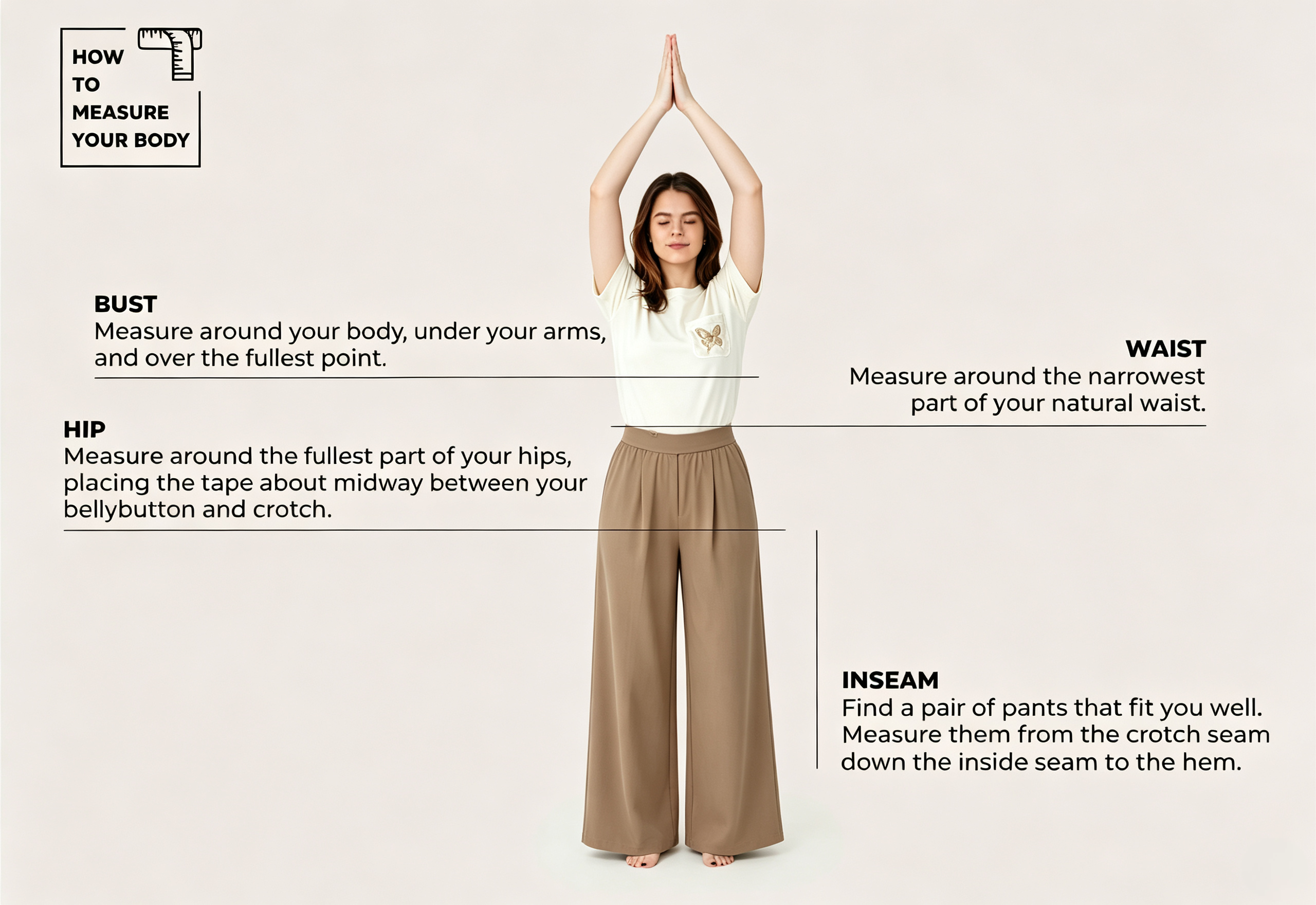
Because regional‑size confusion originates partly from inconsistent measurement‑techniques, S‑sizeHub follows a unified global measurement‑standard for bust, waist and hip: Bust: Measure horizontally around the fullest part of your bust, with tape held level across your back. Do not pull tape tight; keep one finger of loose space underneath. For CN‑size matching, take this measurement over bare skin or a very thin non‑padded top, not a thick push‑up bra. Waist: Wrap tape around your natural waistline‑‑the narrowest part of your torso, above your hip‑bones, not around your trouser‑waistband position. Hip: Measure at the widest horizontal circumference across your buttocks, approximately 20–23 cm down from your natural waist. All three measurements should be recorded in centimetres, as the primary input for our calculator. Inches are accepted as secondary reference‑data only.
How S‑sizeHub Solves International‑Sizing Confusion for New‑Chinese Fashion?
Unlike third‑party global‑size converters such as clothessizehub, ZALORA or BloomChic, which only convert between Western and generic “Asian‑size” labels, our S‑sizeHub system was purpose‑built for cross‑border shoppers purchasing Chinese‑manufactured New‑Chinese‑style clothing. Instead of asking overseas‑customers to select a local‑market size and translate it into another printed label, our workflow reverses this logic: customers submit their own raw bust‑waist‑hip body measurements in centimetres, then the tool calculates the matching official CN shop‑size and displays equivalent reference‑labels across our full 19‑country dataset, covering US, UK, EU, DE, FR, AU, RU, JP, KR, Singapore, Malaysia, Thailand, Vietnam, Indonesia, Philippines and additional markets. Each regional reference value is calculated against its own independent anthropometric baseline table. RU‑size conversions never share formulas with EU, and CN‑size values remain isolated from generic EA‑Asian references. Important Final Disclaimer All international‑size labels shown within S‑sizeHub charts are for reference‑use only. Vanity sizing, fabric‑shrinkage properties (ramie, silk, tencel and woven‑cotton behave differently), designer‑pattern‑ease choices and modest‑wear lengthening adjustments will always alter final‑garment fit. Always cross‑check the finished‑product measurement chart printed on each product page before placing your order.
Getting set up correctly
Use a soft, flexible measuring tape — the kind used for sewing — rather than a rigid carpenter's tape. If you don't have one on hand, a piece of string measured afterward against a rigid ruler works just as well. Measure over the undergarments you would normally wear with the type of clothing you're shopping for, since a padded bra or thick socks can shift a measurement by half an inch or more. Standing naturally, without pulling in your stomach or over-tightening the tape, is essential; the tape should be snug against the skin but not compressing it, and you should be able to slide a finger underneath it. Where possible, have someone else take the measurement for you, since it's difficult to keep a tape level and horizontal around your own back.
Core body measurements, step by step
Chest and bust
For women, measure around the fullest part of the bust while wearing a non-padded bra; this is the number used for tops, dresses, and jackets. Breathe normally rather than expanding your chest for the measurement.
Waist
Your natural waist is the narrowest part of your torso, typically one to two inches above the belly button — not where your jeans usually sit, which is your hip line. Measure at the end of a normal exhale, and repeat two to three times to confirm consistency. The most common mistakes are measuring over thick clothing, pulling the tape too tight, or accidentally measuring at the hip instead.
Hips
Stand with your feet together and measure around the widest part of your hips and buttocks, keeping the tape parallel to the floor.
Inseam
The easiest method is to lay a well-fitting pair of pants flat and measure from the crotch seam straight down to the bottom hem. If measuring on your body, stand against a wall in flat shoes and measure from the inner thigh, where the crotch of your pants sits, straight down to the floor. Standard inseam lengths run short (28–30 in), regular (32 in), long (34 in), and extra-long (36 in); if you're between two lengths, size up, since a longer inseam can be hemmed but a short one can't be lengthened.
Common mistake
1,Pulling the tape too tight
2,Measuring at the hip line instead
3,Feet apart, skewing the tape angle
4,Measuring outseam instead of inseam
5,Measuring while slouching
>>>Using our size converter, you can instantly convert your measurements into corresponding sizes for different countries and brands.